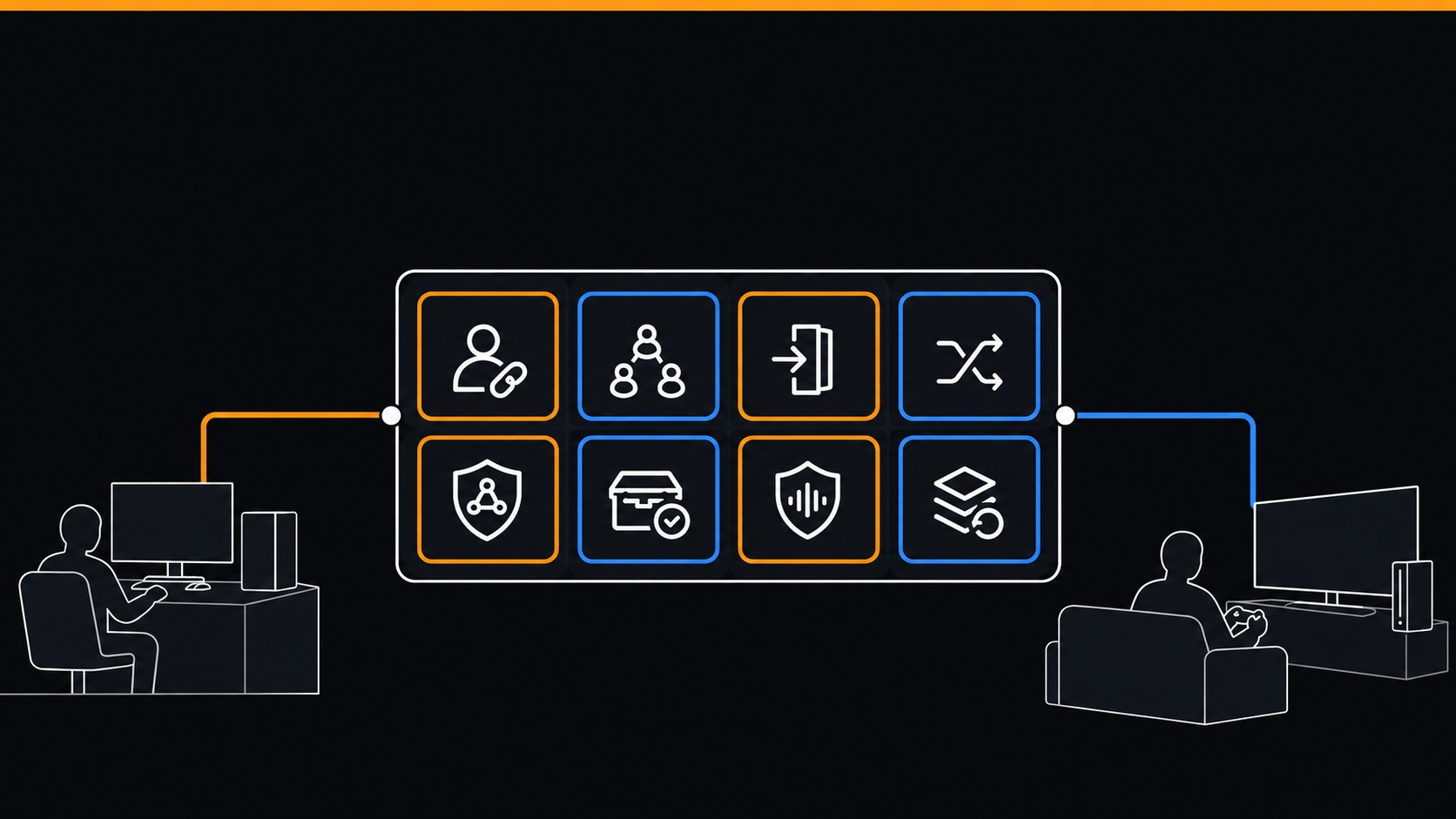
Imagine two players trying to play the same game together. One owns it on Steam. The other is playing on a console.
Both builds can connect to the same dedicated server. The gameplay protocol is compatible. The network test succeeds.
Does the game now support crossplay?
Not necessarily.
Can the two players find each other? Can one invite the other while the game is not running? Do their privacy settings allow them to communicate? Does the matchmaking system place their party in an eligible pool? Do they both own the content required for the selected map? Will they still be able to play together if one platform receives the next update later than the other?
These are not secondary details. Together, they define whether crossplay actually works for the player.
Crossplay is not the ability of two builds to exchange packets. It is the ability of players from different platform ecosystems to complete the same end-to-end journey.
That journey depends on at least eight connected systems.
Why Crossplay Has Become a Product Requirement
Online multiplayer and crossplay are no longer limited to a small category of large competitive games.
The 2026 Unity Game Development Report, drawing in part on a 2025 survey of 300 developers, found that 83% of the surveyed studios support online multiplayer features, while 72% prioritize crossplay. Smaller sessions were especially common, with 55% focusing on groups of two to nine players.
The same report also identified the difficulty behind the opportunity: 38% of respondents said that delivering a consistent user experience across devices and environments was their primary crossplay challenge.
This is the central tension. Crossplay can increase the number of people who can play together, improve matchmaking liquidity, and make expansion to new platforms more valuable. But every additional platform also introduces another identity system, social graph, permission model, store, release process, and operational dependency.
In some cases, crossplay is also a distribution requirement rather than an optional enhancement. The Epic Games Store publishing requirements state that multiplayer games must support crossplay across all PC stores where the product is available.
A game that already has multiplayer on one PC storefront may therefore need much more than a new build when it expands to another. Even if the gameplay netcode remains unchanged, the surrounding player journey may need a store-neutral identity, social, lobby, entitlement, and support layer.
Crossplay, Cross-Progression, and Cross-Entitlement Are Different
Several terms are often grouped together during planning, but they represent different commitments.
Cross-platform means that the game is available on more than one platform.
Crossplay means that players from different platforms or gaming networks can participate in the same multiplayer experience.
Cross-progression means that player progress, characters, settings, or inventory can follow the player between platforms.
Cross-entitlement means that a purchase made through one store or platform is recognized on another.
Cross-generation means that players using different generations of hardware within a platform family can play together.
Supporting one does not automatically provide the others. A game may support crossplay without sharing progression. It may share progression while requiring DLC to be purchased separately on every platform. It may support cross-generation play within one network but not cross-network play with another.
These distinctions should be agreed before choosing a backend or multiplayer platform. Otherwise, a single line in a product roadmap can hide several independent systems and contractual constraints.
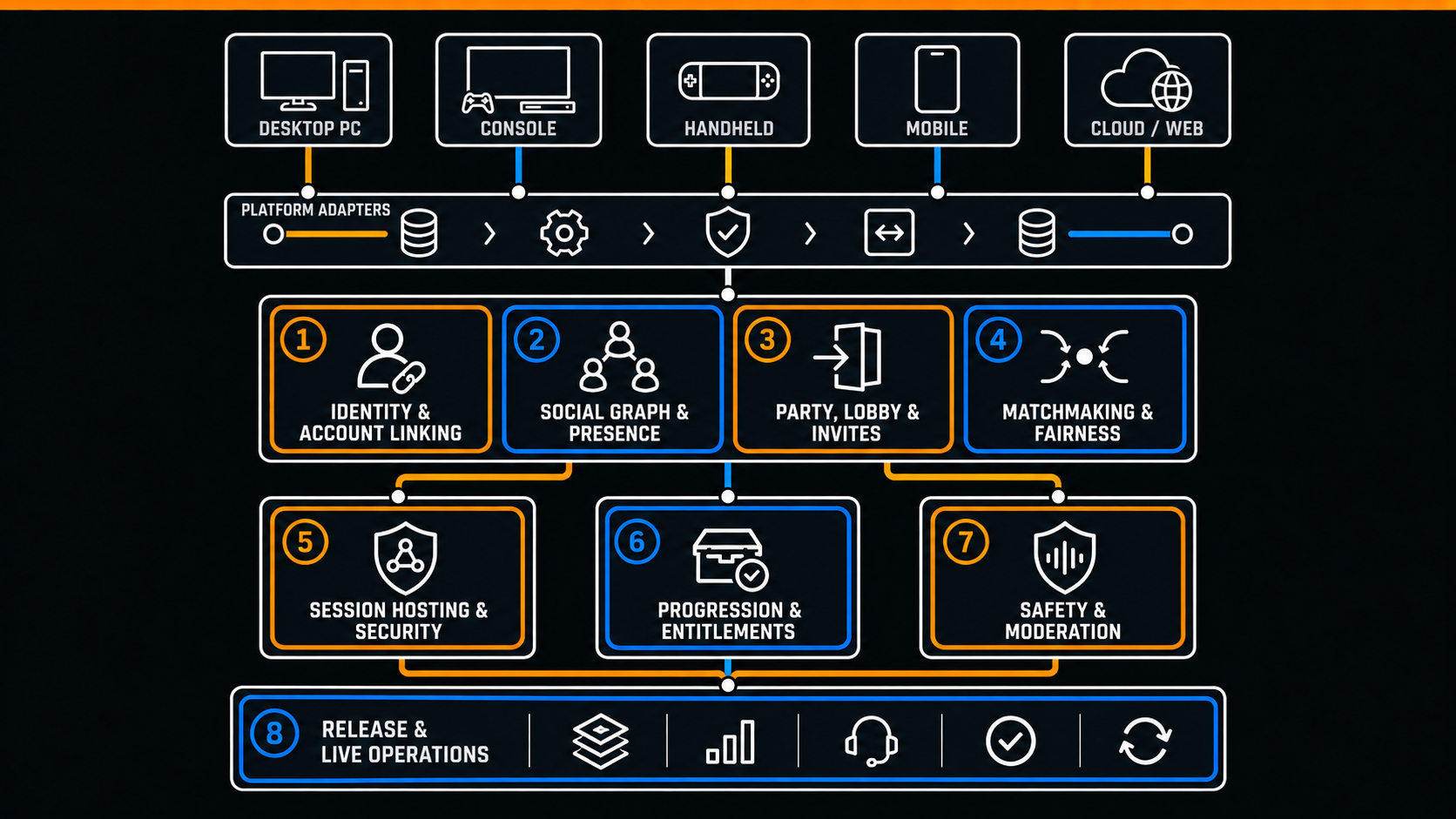
1. Identity and Account Linking
A player may have a Steam ID, an Xbox network identity, an Epic Games account, a PlayStation account, a Nintendo account, or a mobile platform identity. Those identifiers prove who the player is within a specific ecosystem. They do not automatically tell the game that several external accounts belong to the same person.
A production crossplay architecture therefore needs a canonical title-level player identity. Platform identities are securely verified and mapped to that internal player ID rather than being used as the permanent identity for all game data.
This sounds straightforward until existing data is involved.
What happens if a player has already created progress independently on two platforms and then links the accounts? Which profile survives? Can inventories be merged? What happens when an account is unlinked and later connected to another identity? How does customer support reverse an incorrect or fraudulent link without duplicating currency or losing purchases?
Account linking is not one API call. It is a state machine with security, recovery, privacy, and data-ownership consequences.
Platform identity must also be verified on a trusted server. Display names and public profile identifiers are not sufficient proof. Microsoft’s public Xbox requirements specify authenticated platform tokens for publisher-account linking rather than unauthenticated identifiers such as a Gamertag. Steam similarly provides signed session tickets that a game server or secure backend can use to verify identity and application ownership. See the official Xbox requirements and Steam authentication documentation.
The product decision is equally important: must every player create or link a publisher account, or can the game create a title identity silently from the active platform account? The answer affects onboarding friction, account recovery, data portability, support cost, and the ability to add future platforms.
2. Social Graph and Presence
Platform friends do not live in one universal social graph.
A Steam player may have Steam friends, title-level friends, and friends imported through another cross-platform service. A console player may be subject to different rules governing which identities can be displayed, contacted, invited, or blocked.
The game must decide whether to present separate lists or a blended experience. If lists are combined, players still need to understand which relationship comes from which network. Duplicate identities must be resolved. Presence information must explain more than whether someone is online: are they in a joinable party, in a private session, using an incompatible build, or playing content the viewer does not own?
Blocking is part of the same system. A player who is blocked through a native platform should not reappear through an uncoordinated publisher friend list or cross-network chat path.
The Epic Online Services crossplay overlay illustrates the scope of this problem. Its crossplay feature set covers authentication, linked platform accounts, a combined friends list, game invitations, joinability, and platform trust and safety requirements. The value is not simply that several SDK calls are placed behind one interface. The value is that they participate in one coherent player journey.
Before choosing a social or crossplay platform, teams should decide which system is the source of truth for friendships, presence, blocks, recent players, and display names—and what happens when those sources disagree.
3. Parties, Lobbies, Invitations, and Joinability
Party, lobby, and game session are often used interchangeably, but they serve different purposes.
A party is a group of players who may stay together across several activities or matches. A lobby is a pre-game state where players choose settings, characters, maps, or readiness. A game session represents the actual multiplayer activity and its allocated host or server.
Crossplay becomes fragile when all three are represented by one platform-specific lobby object.
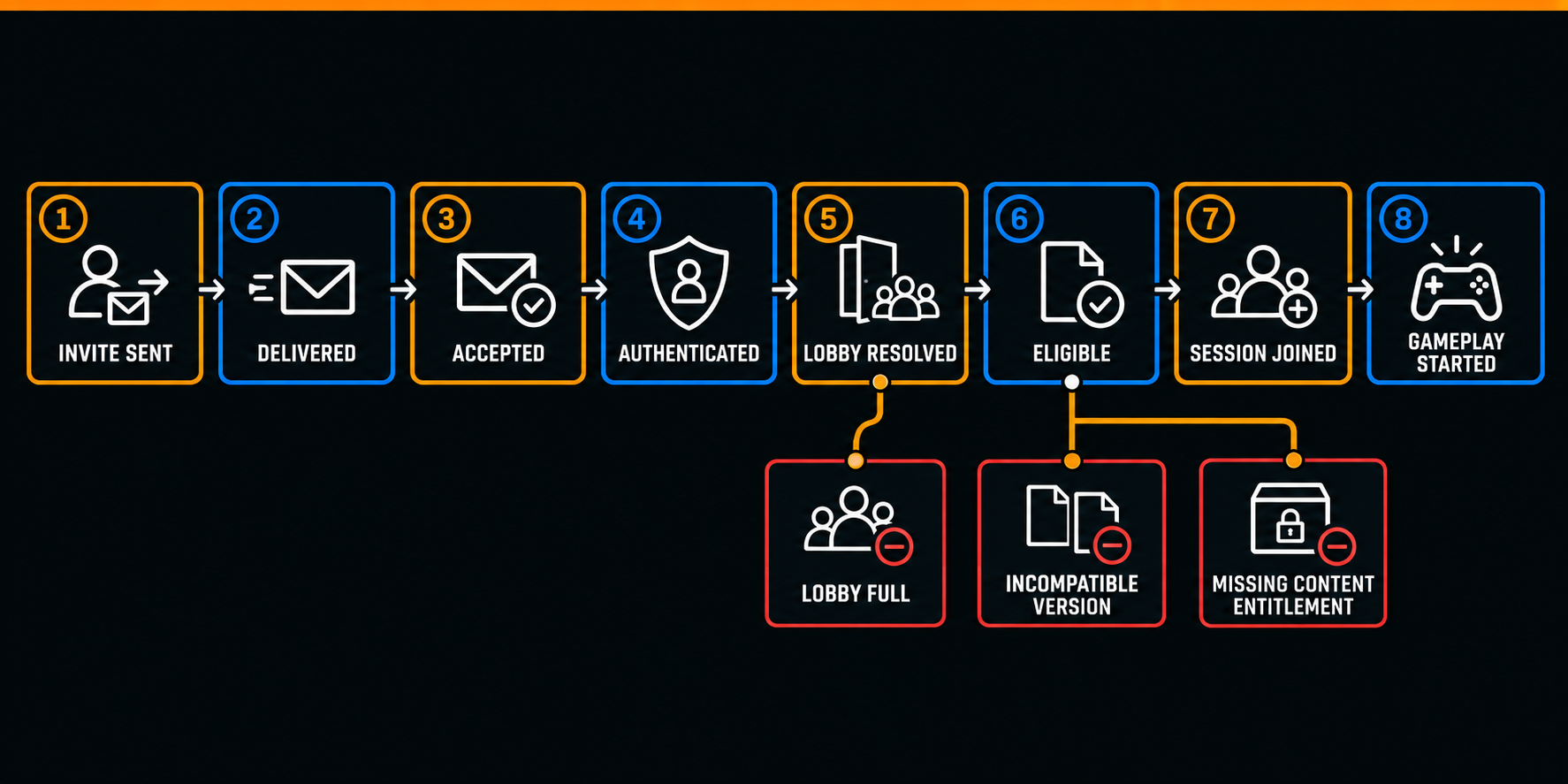
A complete invite flow must work from more than the main menu. A recipient might accept an invitation before the game is running, while playing alone, while already in another multiplayer session, or after the device resumes from suspension. The target lobby may become full before the recipient arrives. The leader may leave. The required content may not be installed. The receiving client may be on an incompatible version.
The system must preserve enough context to authenticate the player, resolve the destination, validate permissions and content, reserve a place where appropriate, and explain a failure when joining is no longer possible.
Microsoft’s public joinable-session requirements demonstrate how broad this flow can be. They test whether invitations and join actions move players into the intended game experience from different title and device states—not merely whether an invite notification appears.
This flow should also be measurable. An effective crossplay funnel records invite sent, delivered, opened, accepted, authenticated, lobby resolved, eligibility checked, session joined, and gameplay started. Without those stages, teams know that invites are failing but not where or why.
4. Matchmaking and Fairness Policy
Crossplay can create a larger potential population while still producing many smaller matchmaking pools.
Players may be divided by crossplay preference, platform permission, input device, region, latency, skill, party composition, anti-cheat capability, client version, age restrictions, and access to specific content. A single player can be eligible for one pool while the rest of the party is not.
The matchmaker therefore needs more than a platform field. It needs an eligibility policy that evaluates the whole party and explains how constraints are expanded as waiting time increases.
The product team must decide whether crossplay is enabled by default, optional, or required. Competitive games may need input-based pools or special treatment for mixed controller and keyboard-and-mouse parties. Cooperative games may prefer population density and lower waiting time over strict separation. Some regions may not have enough concurrent players to support every combination.
There is no universal answer. Fairness is partly a technical problem, but it is also a game-design and community policy.
The relevant metrics should be segmented by platform, input type, region, party type, crossplay setting, and matchmaking rule. Overall average wait time can look healthy while one platform or opt-out pool is effectively unusable.
5. Session Hosting, Networking, and Security
This is the point where most teams initially expect crossplay work to begin.
Once a match is formed, the system must allocate or identify a host, authenticate every participant, select an appropriate region, establish secure connectivity, and maintain the session through disconnections and reconnects.
The architecture may use dedicated servers, peer-to-peer hosting, relays, or a hybrid model. That choice affects latency, operating cost, address exposure, migration behavior, cheat resistance, and platform compliance. A transport supported on one platform may not be the right common layer for every other platform.
Server authority also becomes more important when client capabilities and threat models differ. The game must determine which actions are trusted, which are validated, how bans are enforced across linked identities, and what happens when an anti-cheat component is unavailable on one platform.
Microsoft’s public cross-network multiplayer example shows one possible architecture using a title identity, custom matchmaking, platform session records, and dedicated servers. It is an implementation example rather than a universal prescription, but it demonstrates how networking sits inside a much larger service flow.
Teams should measure server-allocation time, connection success, authentication failure, round-trip time, jitter, packet loss, reconnect success, session completion, and cost per session—not only peak CCU.
6. Progression, Economy, and Entitlements
Crossplay does not automatically mean cross-progression, and cross-progression does not automatically mean cross-buy.
Player level, quest state, earned inventory, premium currency, subscriptions, consumables, and downloadable content may all follow different rules.
A title-level profile can often provide shared progression and earned items. A title-managed wallet may support a unified balance where platform policy permits it. Store-managed DLC, however, may need to be owned separately on each platform. Refunds, family sharing, subscriptions, regional products, and platform-specific bundles introduce further differences.
Microsoft’s cross-network example deliberately separates these cases. It demonstrates a shared title-managed virtual-currency wallet and inventory, while store-managed downloadable-content entitlements remain specific to the store where they were acquired.
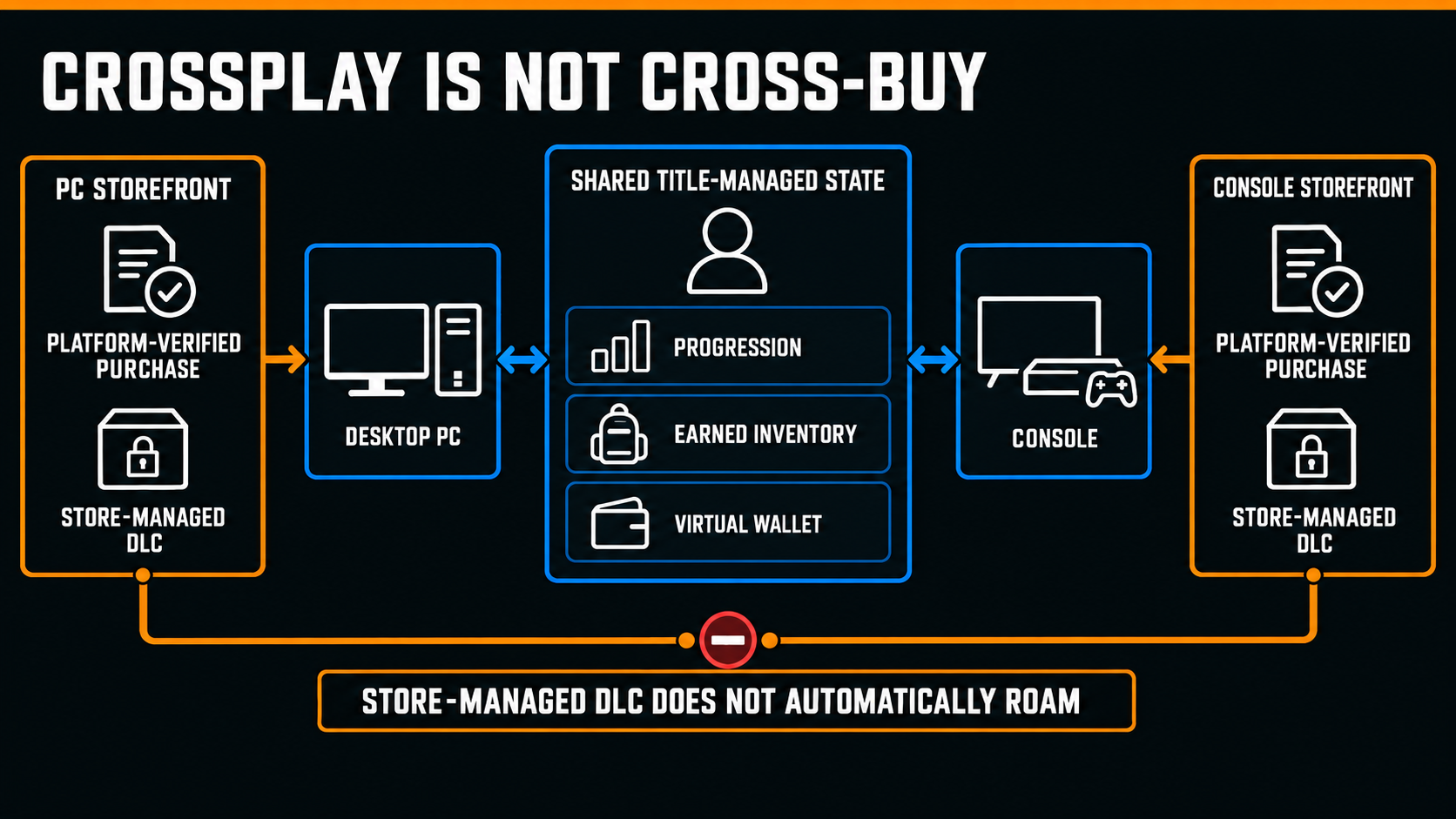
Every cross-platform project should therefore create an entitlement matrix before implementation. For each SKU, currency, item type, subscription, and DLC package, the matrix should record:
- Which system is the source of truth.
- Where the item can be purchased.
- Where it can be consumed or used.
- Whether it can move between platforms.
- How ownership is verified.
- What happens after a refund, chargeback, unlink, or account merge.
- Whether all party members need the entitlement to enter the same session.
Purchase claims must be verified through trusted backend and store interfaces. A client should never be allowed to grant itself an entitlement merely because it reports that a purchase succeeded.
This system directly affects revenue, fraud, customer support, and platform relationships. It should not be left until store integration begins.
7. Communication, Safety, and Moderation
When two networks are connected, their safety models must also be connected.
Voice, text, direct messages, pings, user-generated content, display names, and invitations can all be subject to privacy settings, parental controls, age restrictions, and platform-specific communication permissions.
A cross-network communication service needs to evaluate those permissions at the correct time, including when a new player joins an existing session. Players need ways to mute, block, and report users from other networks. Reports need stable internal identities, evidence, routing, enforcement, and—in many cases—an appeals process.
The Xbox requirements provide a useful public example. They require communication permissions to be respected even when a title uses its own communication service, and require titles to let players mute cross-network participants during a gameplay session. The same requirements also address reporting and handling user-generated content.
The difficult question is ownership. Does the platform handle a report, does the game publisher handle it, or do both? Does a title-level ban affect every linked platform account? How quickly must illegal or high-risk content be removed? How long can evidence be retained in each region?
Safety is not an optional layer added after voice chat works. It is part of whether the crossplay feature is allowed to operate at all.
8. Version Compatibility, Release, and Live Operations
Crossplay must continue working after launch.
Different storefronts and platforms have different build, review, certification, deployment, and rollback processes. If one version is delayed, the shared population may be divided by protocol or content compatibility. A player may remain online with a build that the backend no longer expects.
Teams need an explicit compatibility contract covering client protocol, server protocol, content manifest, data schema, feature flags, and minimum supported version. Backend changes should be backward compatible for an agreed window. New features may need to remain disabled until every required platform is ready.
Operational controls should include platform-specific feature flags, maintenance modes, minimum-version rules, safe configuration rollout, kill switches, and documented rollback procedures.
Observability must also retain crossplay context. Useful events and traces should include the canonical player ID, platform and storefront, client build, protocol and content version, input type, crossplay setting, matchmaking pool, party ID, lobby ID, match ID, server region, and consistent result codes.
Without that context, an incident appears as a general matchmaking or connection failure. With it, the team may discover that the failure affects only one storefront build, mixed-input parties, or players joining from a suspended state.
A crossplay demo proves that clients can connect. A production-ready crossplay service proves that every failure path can be explained, measured, and recovered.
What a Crossplay Platform Can—and Cannot—Decide for You
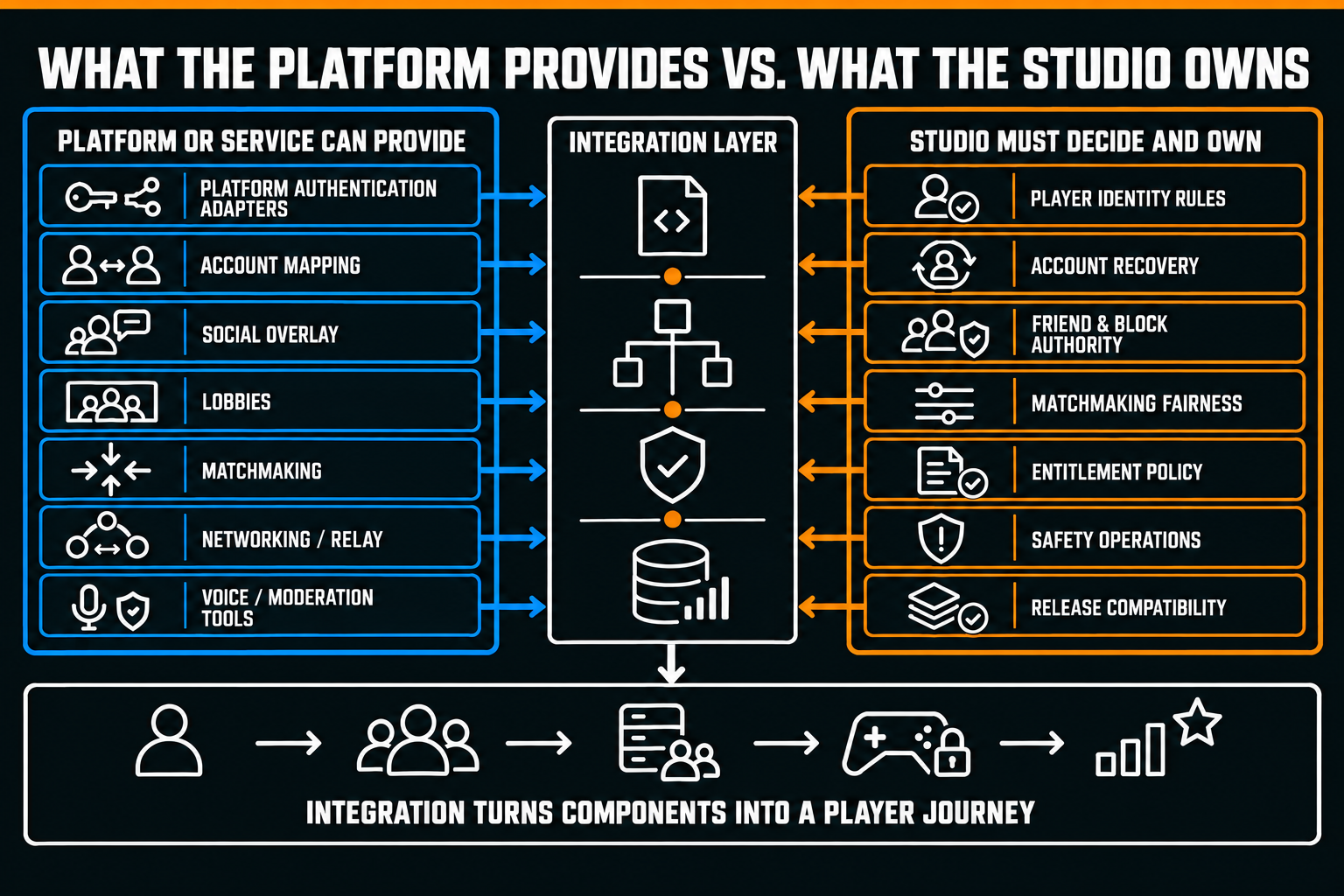
A cross-platform service can remove a great deal of commodity work. Depending on the product, it may provide platform authentication adapters, account mapping, social overlays, lobbies, matchmaking, relays, dedicated-server allocation, voice communication, moderation tools, or economy services.
That does not make crossplay a finished feature.
The studio still needs to decide:
- What represents the canonical player.
- How accounts are linked, merged, unlinked, recovered, and deleted.
- Which friend, block, and presence data is authoritative.
- Which players are eligible to enter the same matchmaking pool.
- What fairness rules apply to platforms and input devices.
- Which progression, currencies, items, and purchases can move.
- Who owns reports, bans, appeals, and safety operations.
- How incompatible releases and service failures are handled.
- Which data is available for debugging, support, and migration.
This is why the useful choice is rarely just build versus buy.
A better question is:
Which components can we buy, which policies must we own, and who will integrate them into one reliable player journey?
Eight Questions to Ask Before Selecting a Platform
Before committing to a crossplay architecture or backend provider, a team should be able to answer eight practical questions.
- What is our canonical player identity, and how are link, merge, unlink, recovery, and deletion handled?
- How will native and title-level friends, presence, recent players, and blocks work together?
- Which invite and join paths must work from cold start, suspension, another session, or a full lobby?
- How will matchmaking treat platform, input, region, latency, party composition, permissions, and crossplay preference?
- Which hosting, transport, authority, anti-cheat, reconnect, and regional model fits the game?
- Which progression, currency, inventory, subscription, and DLC rights can move between platforms?
- How will privacy, child accounts, communication permissions, reporting, moderation, and enforcement be operated?
- How will version compatibility, certification delays, staged rollout, observability, support, and rollback work after launch?
If the answer to several of these questions is simply “the platform handles it,” the integration boundary is probably not understood yet.
The Player Should Not See the Boundary
The best crossplay experience feels uneventful.
Players identify their friends, form a party, join a suitable match, communicate according to their permissions, receive the correct rewards, and return after the next update without needing to understand which services or platform rules made it possible.
Achieving that simplicity requires significant coordination behind the screen.
Crossplay is an identity problem, a social problem, a matchmaking and fairness problem, a networking problem, an economy problem, a safety problem, and an operational problem. Treating it as one SDK task usually moves those decisions later, where they become more expensive and harder to change.
The safest time to discover a missing crossplay system is before announcing another platform.
At CosmoUniverse, we help game teams evaluate backend and multiplayer platforms, define integration boundaries, and prepare online services from architecture and implementation through launch and live operation. The first step is not choosing an SDK. It is mapping the complete player journey and assigning a clear owner and source of truth to every system behind it.